 Issue 125
 Issue 124
 Issue 123
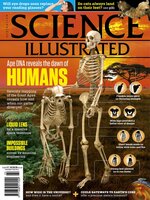 Issue 122
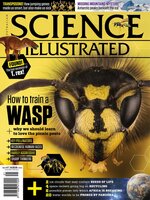 Issue 121
 Issue 120
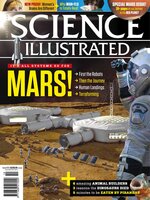 Issue 119
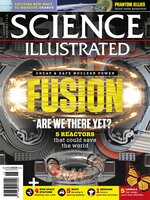 Issue 118
 Issue 117
 Issue 116
 Issue 115
 Issue 114
 Issue 113
 Issue 112
 Issue 111
 Issue 110
 Issue 109
 Issue 108
 Issue 107
 Issue 106
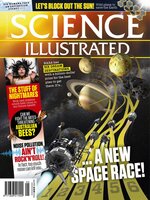 Issue 105
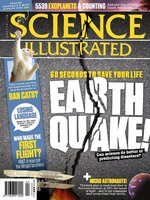 Issue 104
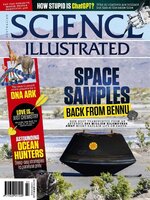 Issue 103
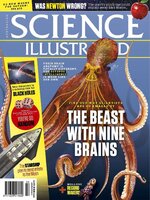 Issue 102
Science Illustrated delivers natural science, break through discoveries and an understanding of the world for the entire family. Packed with stunning photography and in-depth editorial it’s a visually spectacular gateway to the world looking into the beginning of life to distant objects in the universe.
SUBSCRIBE & START SAVING NOW!
Science Illustrated
MEGAPIXEL
‘Failed’ stars might hold dark matter secrets • Most of the matter in the universe is invisible, and still largely unexplained. Researchers think the mysterious matter could be found inside dark stars.
Explosion created dark matter • Researchers have several theories for the elusive dark matter. A recent one is that it formed in a post-Big Bang explosion.
Reef recognition • The UN has awarded special recognition to a project that has re-seeded Australian oyster and mussel reefs in 21 locations.
Bacterial fibres weave a paper-thin material stronger than steel • A supermaterial produced by bacteria could provide valuable assistance in one of the world’s biggest environmental problems: plastic pollution.
Viruses take the body by surprise • Our immune system normally combats viruses, but when intruders escape the defence, consequences can be severe.
100-year-old lungs cough up Spanish flu’s hidden clues • A century-old preserved lung has been helping researchers understand how one of history’s worst pandemics developed. Their findings could prove crucial in combating the next one.
Plasma oscillation mode over Jupiter entirely new to science • Days before NASA’s Juno probe ended its final mission, researchers announced that its data had identified a phenomenon at Jupiter’s north pole which breaks existing models.
Footprints reveal herd of dinosaurs • A discovery in Canada shows that herbivorous dinosaurs may have used the same predator protection strategy as zebras and wildebeests today.
What happens inside a particle accelerator? • “Accelerators looks amazing and I understand they are used to find new particles, but how do they work, and why are they so large?”
Do older people get runnier noses? • “I have never suffered from allergies, but I find my nose running much more often than it did when I was younger. Is this an age thing?”
TEST YOURSELF
Why does it hurt so much to bang an elbow? • “What’s with the extreme pain when I knock the outside of my elbow? Why does it hurt so much more than a blow to other parts of the body?”
Red hair, blue eyes: how rare? • “I have blue eyes and red hair, and people always say it’s really unusual. But how unusual, and what causes it?”
What happens if an astronaut is sucked into a black hole? • In the film ‘Interstellar’, the main character Cooper crosses the event horizon of a black hole, yet survives. How would an astronaut fare in real life?
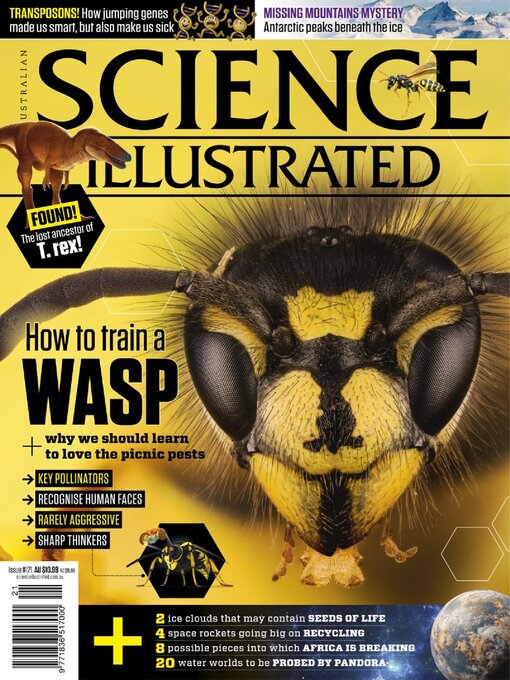
HOW TO TRAIN A WASP • Many people actively dislike wasps, yet the winged creatures are extremely beneficial to both the planet and the economy. They can also prove rather charming, and you can train them, just like you train your dog.
A wasp brain is small but sharp • Their brains are smaller than a grain of rice, yet wasps exhibit surprisingly complex behaviour and have well-developed skills in areas such as memory and learning.
How to train a wasp • Researchers have trained wasps to distinguish between colours. The method is simple and similar to dog training. The key is treats.
ROCKET SCIENCE IS ALL ABOUT RECYCLING • Faster, cheaper and greener are the new requirements for space travel, so researchers are busy developing reusable equipment. Heat is the big enemy, so perhaps rockets should learn how to ‘sweat’.
Private space rocket leads the way • The Falcon 9 rocket from SpaceX has demonstrated that...